Lebanon Hills Sustainable Trails Project
In 2023, the county completed the Sustainable Trail Study at Lebanon Hills Regional Park. It looked at all 50 miles of trails in the park and identified ways to:
- Achieve safe, sustainable trails throughout the park
- Improve ADA accessibility
- Provide quality nature-based visitor experiences
The county used the study to create a plan outlining which trail improvements to make first and how much they will cost. The plan provides a maintenance schedule for keeping the trail system high-quality and more sustainable.
In some cases, trails will be removed or realigned. These changes will decrease natural resource impacts and improve visitor experiences.
Some trail segments have deep gullies or loose gravel. These conditions can be a safety concern for trail users. When finished, the trail system will be safer, better for the environment and cheaper to maintain .
For background, review the Lebanon Hills Regional Park Master Plan and Natural Resources Management Plan.
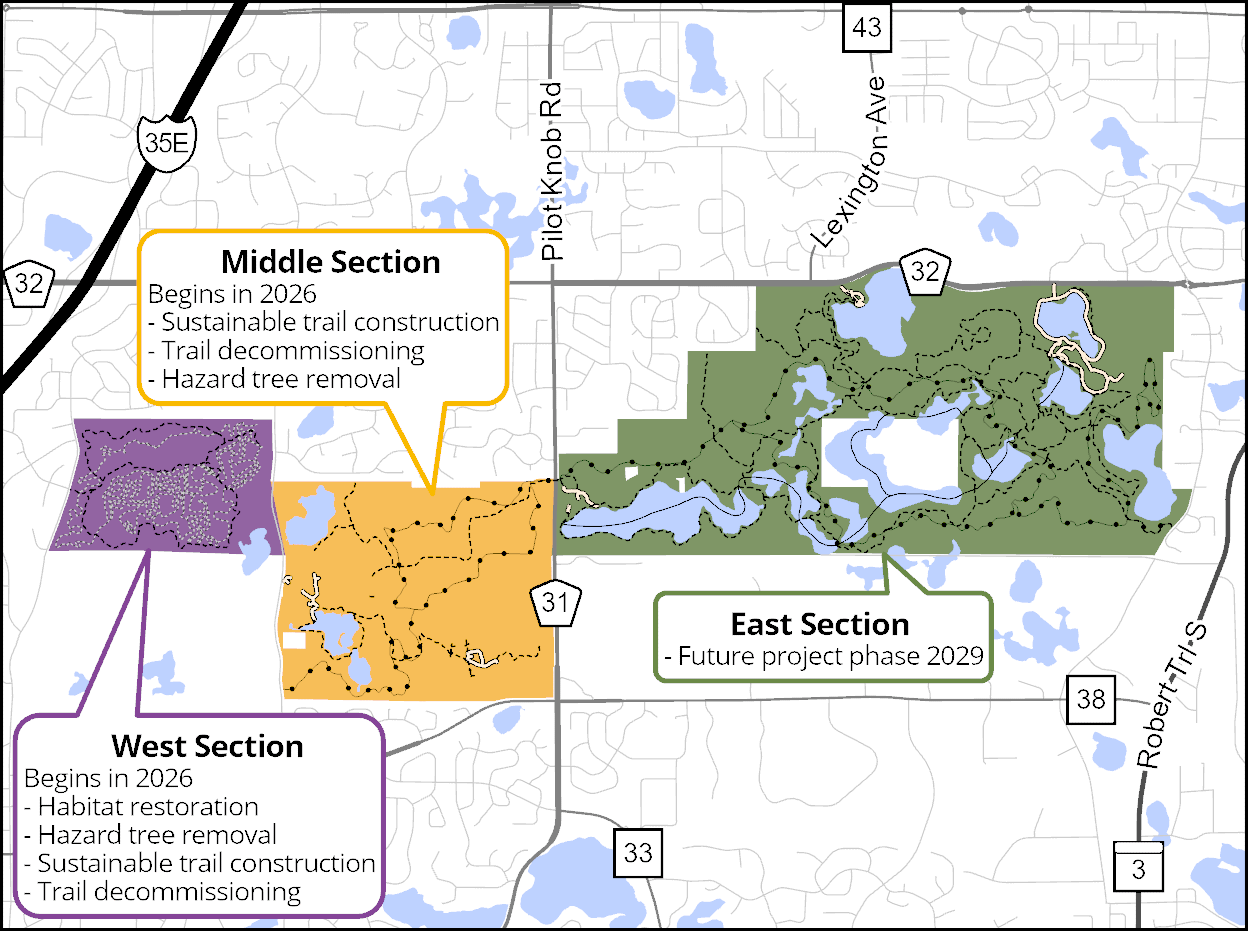
Project timeline
West section
Galaxie Avenue to Johnny Cake Ridge Road
-
Buckthorn removal
Hand crews with minimal trail impacts.
August-November 2026
-
Buckthorn and selective tree removal
Expect periodic trail closures
November 2026-March 2027
-
Trail construction begins
Spring 2027
-
Trail work complete
Winter 2027
-
Natural resource restoration complete
December 2029
Middle section
Johnny Cake Ridge Road to Pilot Knob Road
-
Trail construction begins
Fall 2026
-
Hazard tree removal
Fall-winter 2027
-
Trail work complete
Summer 2028
East section
Pilot Knob Road to Dodd Road
-
Future project phase
2029
Project components
Creating high-quality habitat
Lebanon Hills Regional Park’s west section has had very few natural improvements since becoming a county park. This area was once a rich and diverse landscape. It had oak savannas on the hilltops and open oak woodlands filled with a mix of wildflowers and grasses that provided habitat for diverse wildlife.
Unwanted trees and invasive shrubs — like buckthorn — have taken over. These plants crowd out native wildflowers and grasses. They also make it hard for new oak trees to grow, which leaves the park with an aging tree canopy that impacts future tree growth.
This project will help restore the land. Crews will remove buckthorn and other unwanted trees choking out 200-plus-year-old bur oaks. We will then plant native seeds and small plants grown in the county’s greenhouse. This will help create a strong, healthy habitat where plants and wildlife can thrive.
Restoration work: Messy at first
To create a sustainable and healthy landscape, this project needs to undo over a century’s worth of unwanted and invasive trees left unchecked due to the disruption of many natural processes that this ecosystem depended on. Because of this, the work can look messy and even destructive at first.
Crews will use heavy equipment to remove large areas of buckthorn across the 210-acre site. Machines will cut and grind the shrubs. After this, you will see what looks like mulch covering the ground. This is normal. The mulch will break down over time and help new plants grow.
At first, the area may look very different. A thick, closed forest will suddenly feel open. You may see tracks from equipment and views along the trail will change. You might even see farther across the park than before.
What to expect
After the buckthorn and unwanted trees are removed, it may seem like nothing is growing. This is normal. Nature takes time to recover.
We often describe this process as “sleep, creep, leap.”
- Sleep (year 1): Not much growth is visible. Seeds are getting established underground.
- Creep (year 2): More plants appear, but there are few flowers. Roots are growing deeper.
- Leap (year 3): Many flowers bloom. Grasses and plants fill in, helping the land stay healthy.
Proven results
This type of restoration has worked well in other parts of the park. Areas around Schulze and Holland lakes are good examples. These areas were restored using the same process and are now full of native plants and wildlife.
Please be patient
We know the park will look different for a while. It may seem messy, and the changes can feel surprising. Over time, the land will recover and become healthier than before.
When the project is complete, the west section of the park will be a thriving habitat. We hope you’ll enjoy exploring it.
Protecting high-quality trail experiences
Trails will be designed to give users access to scenic views, landscapes and terrain. These features help create a more enjoyable and memorable outdoor experience.
Improving accessibility for all users
People with physical disabilities will be able to explore more. We’ll do this by reducing steep slopes, widening trails and improving surfaces — especially on popular routes like lake loops.
Reducing conflicts and improving safety
The new system will make the trails safer. For example, intersections between skate skiing and winter mountain biking can be dangerous due to poor visibility. These areas will be redesigned or removed to lower the risk of collisions.
Reducing trail erosion
Some trails, especially those that go straight up or down hills, are more likely to erode. We plan to replace these with trails that follow the side of a hill. Side-slope trails allow for better water drainage and help protect the soil from erosion.
Protecting natural and cultural resources
Trails that impact sensitive areas — such as certain plants, water, wildlife habitat or cultural sites — will be moved or improved to reduce damage.
Ensuring long-term sustainability
Trails will be designed and maintained to handle heavy use while requiring less long-term upkeep. Segments that show early signs of wear will be addressed promptly to prevent more serious damage in the future.
Let us know what you think
Contacts
For questions or information about buckthorn removal and natural resource restoration:
Max Samuelson, Natural Resource Specialist
max.samuelson@co.dakota.mn.us
952-891-7965
For questions or information about trail construction and general project questions:
Mike Adams, Greenways Senior Project Manager
mike.adams@co.dakota.mn.us
651-554-6538
Funding for this project is provided by the Minnesota Environment and Natural Resources Trust Fund.